AI is rewriting the office market – and it's arriving exactly where we've been since 2021
- Szilvia Németh

- 3 days ago
- 4 min read

Key takeaways
According to IWG's July 2026 survey, 60% of CEOs can't predict how much office space they'll need two years from now – because of AI.
88% say this is why they need flexibility in their workspace and real estate strategy.
Yet the office isn't disappearing: 76% say its role will grow more important. They're not fleeing the office – they're fleeing long leases.
As a freelancer or small team, you face the same dilemma – except for you it isn't strategy, it's a monthly cost.
If you work as a freelancer, a solo entrepreneur, a small team or a business owner, this feeling is probably familiar: you have no idea how many people you'll be working with, or how much space you'll need, eighteen months from now. Scaling up? Pulling back? Who knows. It turns out the CEOs of large corporations feel exactly the same way, and it's reshaping the entire office market.
The numbers behind flexible office use, backed by real research
According to a July 2026 survey of CEOs and CFOs by International Workplace Group (IWG – the operator of the Regus and Spaces brands), 60% of respondents believe the rise of AI has made it harder to predict how much office space their organisation will need over the next two years. 88% of CEOs say that because of AI, companies need flexibility in their workspace and real estate strategy.
And they're not just talking about it. 99.8% of CEOs and CFOs say their organisation is actively working to shift part of its fixed real estate costs into flexible, variable costs. The majority are already investing in hybrid workspace solutions, and many are building office networks closer to where employees live or moving toward a decentralised model altogether.
Here's the important twist: the office isn't disappearing. 76% of CEOs say the role of the office will actually grow more important over the next two years, and just 0.8% expect it to become less important. In other words, they're not fleeing the office – they're fleeing long, rigid leases.
Key findings from the IWG survey
What was measured | Share |
Harder to predict two-year office needs because of AI | 60% |
Flexibility is needed in workspace and real estate strategy | 88% |
Actively shifting fixed real estate costs into variable costs | 99.8% |
Already investing in hybrid workspace solutions | 57% |
Building an office network closer to where employees live | 55% |
Considering a decentralised model | 52% |
Say the office will become more important over the next 2 years | 76% |
Say the office will become less important over the next 2 years | 0.8% |
Source: International Workplace Group (IWG), July 2026 – survey of CEOs and CFOs.
One figure worth treating separately, because it doesn't come from this survey: a 2025 study by IWG and Arup found that companies which build local, flexible workspaces into their hybrid model could raise productivity by up to 11% over five years. It's a modelled, international estimate – not a guarantee, and not a Hungarian figure – but the direction is telling.
Why should you care if you don't run a multinational?
Because what's a strategic question for the big players is everyday life for the smaller ones. A 5,000-person company can afford to live with a wrong office decision for two years. A freelancer or a three-person team can't. For you, flexibility isn't a slide in a deck – it's a matter of survival.

Does this apply to you?
You don't know whether you'll be working with one person or five next spring.
You have a fixed office you pay for while it sits empty half the week.
You occasionally need a proper meeting room for a client, but don't want to commit to one for years.
Your team lives half a city apart, and everyone hates commuting downtown.
You'd like a business address, a reception and a meeting room – but not the overheads of a whole floor.
If any of these ring true, the question isn't "should I rent an office or not." It's how to avoid committing to something you won't be able to use in two years' time.
The practical part: how to do it smartly
Start small, and let your costs follow your real needs, not the other way round. Pick a few days a week, flexibly – not just a fixed Monday-to-Friday period. Choose a location close to you, because the commute you save is the easiest productivity gain there is. Pay for the meeting room when you actually need it, rather than keeping one on standby. And before you sign anything, try it – a single day working in a space tells you more than ten photos.
What Flexi has been doing since 2021
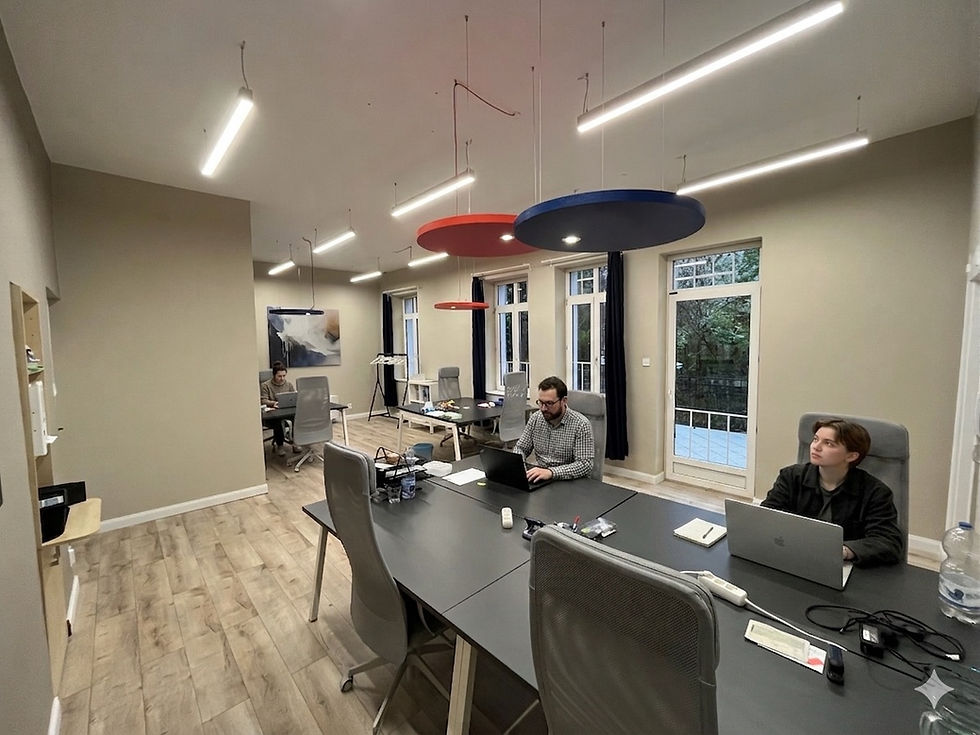
For us, none of this is a new discovery. Flexi Offices launched in 2021 for exactly this: flexible, decentralised office use, now with two locations on the Buda side, built around community. What IWG is now measuring among corporate CEOs, we've been seeing in our own corridors for years – except here it's freelancers, solo entrepreneurs and small teams living it day to day. The big companies are only now arriving where you can already be today.
If you're curious what an office that adapts to you – rather than the reverse – feels like, come and see both of our Buda locations: Csévi Flexi Offices in Pasarét and Regina Villa Flexi Offices. We'd be glad to give you a free tour and a test day, so you can try it in person before you decide anything.
Sources
International Workplace Group (IWG) – Survey of CEOs and CFOs on AI and office strategy ("From long leases to liquid space"), July 2026. Full text (reproduction): https://it-online.co.za/2026/07/10/ai-makes-future-workspace-needs-harder-to-predict/
International Workplace Group (IWG) & Arup – Hybrid Working Productivity Report (source of the 11% productivity figure), 30 June 2025. https://work.iwgplc.com/MediaCentre/PressRelease/hybrid-working-can-boost-productivity-by-11-percent
irodakereso.hu – "A mesterséges intelligencia átírja az irodapiacot: a cégek egyre inkább a rugalmas irodahasználatot választják" (the Hungarian article that raised the topic), 13 July 2026. https://www.irodakereso.hu/cikkek/irodapiaci-hirek/a-mesterseges-intelligencia-atirja-az-irodapiacot-a-cegek-egyre-inkabb-a-rugalmas-irodahasznalatot-valasztjak